Illusion of Meritocracy
Published: April 28, 2026
Is it even fucking possible?....
.
In the small Himalayan nation of Nepal, September 2025 became a month that will likely be remembered for generations. Streets that once carried the ordinary rhythm of everyday life turned into battlegrounds of anger, hope, and rebellion. For the first time in modern Nepalese political history, the country witnessed an unprecedented violent uprising led not by traditional political forces, but by a digitally mobilized generation of young citizens, Generation Z. It was not a revolution driven by party ideology, Marxist textbooks, or speeches from old revolutionary leaders. It was driven by frustration. It was driven by humiliation. And most of all, it was driven by exposure. Social media, in a way that no newspaper or television station ever could, showed Nepalese youth what was happening behind the curtains: nepotism disguised as patriotism, corruption hidden behind slogans of revolution, and elite families controlling the state as if Nepal were their private inheritance. Young people who had grown up hearing political promises finally saw the reality, appointments based on loyalty rather than ability, government contracts distributed like gifts, and ‘communist leaders’ living in luxury while preaching sacrifice to the public. The Gen-Z Revolution was not just political, it was psychological. It shattered the illusion that the system was broken by accident. Instead, it revealed that the system was designed to benefit a few. By February 2026, the uprising bore fruit. The regime collapsed. A new political wave, led by an anti-establishment, anti-corruption party, rose to power. At the center of this national transformation stood 35-year-old Balendra ‘Balen’ Shah, a symbol of rebellion, modern leadership, and youth-driven governance. To many Nepalese young adults and teenagers, Balen was more than a politician, he was a messiah figure, a representation of everything the old elite was not. But amid the celebration, amid the victory speeches, amid the national relief that ‘we finally won,’ there was a quiet moment that raised an uncomfortable question within me. Prime Minister Balendra Shah chose his former personal assistant from his mayoral days as Kathmandu’s mayor to become the education minister. Another ministry was handed to his college mate. By all accounts, these individuals appeared qualified: educational achievements, experience, and professional competence. Yet something about the appointments felt strangely familiar. Not necessarily corrupt. Not necessarily wrong. But familiar. It was the pattern: trust circles, inner networks, and personal proximity to power. That is when the deeper question surfaced, one that even Nepalese citizens might have missed in the emotional rush of victory. Is true meritocracy even possible? Or is meritocracy itself just another illusion, a fever dream, an unattainable utopia?
.
.
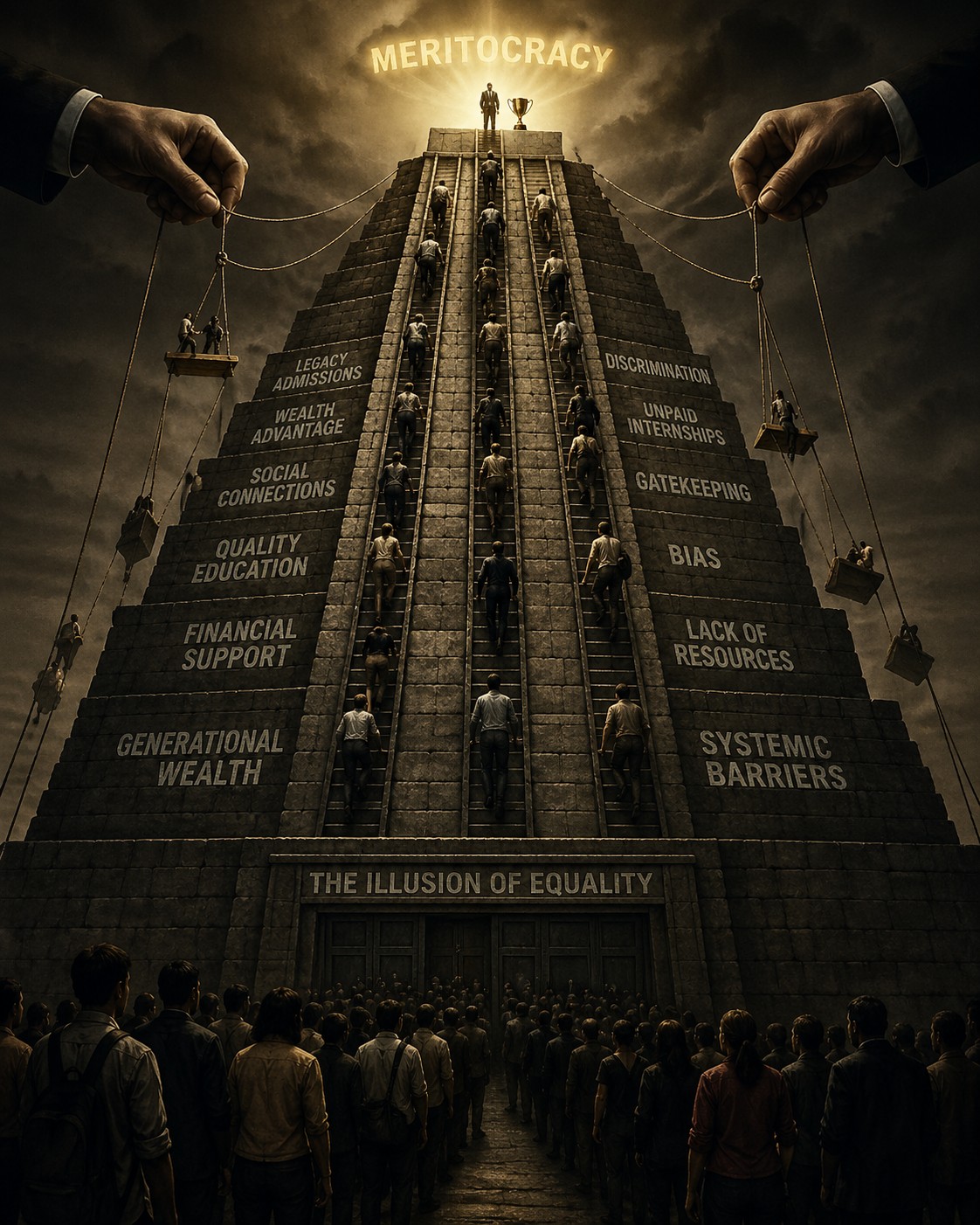
Meritocracy – An Introduction Meritocracy is a system where people rise based on merit, meaning talent, ability, intelligence, hard work, and performance. In a meritocratic society, the best person gets the job, the most capable student earns the scholarship, and leadership positions go to those most competent. In theory, meritocracy is simple and morally attractive. It promises fairness. It tells the poor child in a remote village that success is possible. It reassures society that competence matters more than surname. The concept became especially popular in modern democracies because it appears to offer an alternative to old systems like monarchy (power by bloodline), aristocracy (power by class), caste hierarchy (power by birth), and nepotism and patronage (power by connections). Meritocracy is often marketed as the ideal system’ for a modern nation. It is the foundation of slogans like equal opportunity, fair competition, and hard work pays off. But that is the theory. The real question is whether meritocracy exists in practice or whether it only exists as a myth used to justify inequality. Why Do People Still Believe in It? Despite criticism, meritocracy remains one of the most powerful political ideals. And for good reasons. If it were real, it would solve many of society’s deepest problems. A meritocratic system ensures that the most capable people handle critical responsibilities. This improves governance, institutions, and service delivery. When the most qualified person becomes Education Minister, society benefits. Meritocracy motivates people. If citizens believe effort will be rewarded, they study harder, innovate more, and contribute to the economy. It builds productivity. Meritocracy directly challenges feudal traditions. In a country like Nepal, where family networks and elite privilege have long shaped politics, meritocracy represents liberation. When appointments and promotions are fair, citizens trust institutions. Corruption declines because people no longer feel forced to bribe or beg for opportunities. Competence-driven leadership strengthens education, infrastructure, healthcare, and economic planning. Meritocracy is often associated with rapid development models seen in successful nations. In short, meritocracy is attractive because it feels like justice. But that is exactly why it can also be dangerous. Is Meritocracy an Illusion? Meritocracy is often treated as a moral truth, if you work hard, you deserve success. But this belief ignores one uncomfortable reality: “Merit does not exist in a vacuum. Merit is produced.” A child born in a wealthy family attends better schools, has access to tutors, speaks fluent English, owns a laptop, and has the confidence to participate in debates. A child born in rural Africa may walk to school for hours, study with no electricity, and lack teachers. When both compete, the winner is declared more talented, but society forgets that one was trained for success from birth. This is where meritocracy begins to collapse. Meritocracy often becomes a system where privilege is mistaken for talent. Elite families send children abroad for education, return with degrees, and occupy leadership positions. They appear ‘meritorious’ on paper, but the opportunity itself was inherited. So, meritocracy can easily become a polite version of elitism, a justification for inequality, and a mask worn by the powerful. And once meritocracy becomes an ideology rather than a system, it becomes even more harmful. Because if the poor population fails, society does not blame the system, it blames the poor. Is True Meritocracy Just a Dream? True meritocracy is extremely difficult, but not entirely impossible. However, the version of meritocracy most societies imagine, a perfectly fair competition where only skill decides outcomes, is likely unattainable. Why? Because merit is influenced by family background, wealth, education, nutrition, language skills, access to technology, discrimination, geography, political networks, and social confidence. A society cannot simply declare meritocracy into existence. It must manufacture equal conditions, and that is costly, politically difficult, and often resisted by the elite. Yet, while pure meritocracy may be utopian, a relative meritocracy system where competence matters more than connections is achievable. The real goal is not perfection. The real goal is reducing unfair advantages. Is True Meritocracy Possible? If any country wants to build a truly merit-based system, it must go beyond slogans. It must redesign institutions. Government positions must be filled with clear criteria, competitive exams, and publicly documented interviews. The process should be open to scrutiny. Bodies like Public Service Commissions must be politically insulated. Without independence, merit-based recruitment becomes meaningless. If a Prime Minister appoints friends, classmates, or former assistants, there should be mandatory transparency, parliamentary questioning, and institutional review. This does not mean friends cannot be qualified, it means trust cannot replace process. Meritocracy begins in childhood. If education is unequal, meritocracy becomes a lie. A society needs rural school investment, teacher accountability, scholarship expansion, and quality public universities. Meritocracy cannot exist in a corrupt economy. When bribery buys jobs, talent becomes irrelevant. Corruption is the natural enemy of merit. If marginalized communities remain excluded due to caste, gender, or geography, meritocracy becomes a privilege contest. Inclusion ensures merit is discovered. In short, meritocracy requires a strong state, honest institutions, and long-term policy discipline. No society is perfectly meritocratic, but some have built systems that come close in specific areas. Singapore is widely considered one of the strongest examples of merit-based governance. Its bureaucracy rewards competence, efficiency, and performance. Scholarships are competitive, and civil service promotion is structured. However, critics argue Singapore’s meritocracy still favors those who succeed early, creating a rigid elite class. Finland’s education system is famous for reducing inequality. When everyone has access to high-quality education, competition becomes fairer. This strengthens merit-based success. Finland shows that the foundation of meritocracy is not competition—it is equal preparation. These countries use competitive examinations to determine academic and professional opportunities. This reduces nepotism but introduces intense pressure. They prove that standardized systems can promote merit but also create mental health and social problems. These examples show something important: Meritocracy can be built but it always comes with consequences. Does Meritocracy Creates New Inequality? Even if meritocracy works, it produces a strange paradox, meritocracy can create a new elite that believes it morally deserves power. This is where meritocracy becomes dangerous. In old aristocracies, elites knew they inherited privilege. In meritocracies, elites believe they earned privilege. This makes them less empathetic and more arrogant. The poor are no longer seen as unlucky; they are seen as lazy. If everything depends on merit, society becomes obsessed with rankings, exams, CVs, and achievements. Human worth becomes tied to productivity. People begin to feel like failures if they do not win. This is visible in high-pressure education systems. Meritocracy can weaken community values. Instead of solidarity, people become competitors. Meritocracy often ignores discrimination. Women, minorities, and marginalized groups may still face barriers even if they are equally talented. So even a well-functioning meritocracy can become morally brutal. How Do You Tackle the Problems of Meritocracy? A healthy society must balance merit with humanity. Merit-based systems should not abandon the weak. Welfare policies ensure that people who fail in competition are not destroyed. Governments must openly acknowledge that some citizens start at a disadvantage. Policies like scholarships, quotas, and rural development reduce unfairness. Not all merit is academic. A society must value skills, creativity, leadership, craftsmanship, and community contribution. Even if leaders want to appoint trusted individuals, systems must ensure fairness through oversight, audits, and transparency. Meritocratic winners must be educated to understand privilege. Otherwise, they become a new aristocracy. Meritocracy must be paired with ethics. When Meritocracy Goes Wrong A powerful example of meritocracy producing harmful outcomes is the exam-driven culture in South Korea and Civil Service of India. South Korea is admired for educational excellence and competitive recruitment systems. Students work incredibly hard. University entrance is merit-based through exams. Careers depend on performance. But the result has been extreme stress, high suicide rates among students, a booming private tutoring industry, and widening inequality because rich families can buy better preparation. Or in case of Indian Civil Service, bureaucrats running the country and being knee deep in politics and corruption and everything else wrong in the society. This is a classic case of meritocracy gone wrong. Even though the system is merit-based, it produces a society where childhood becomes a battlefield and success becomes an obsession. The irony is painful, a system meant to reward talent ends up rewarding endurance, wealth-based preparation, and psychological sacrifice. Meritocracy has become a machine. Nepal’s Case Returning to Nepal, the question is not whether Balen Shah’s chosen ministers are qualified. They might be. In fragile democracies, leaders often appoint close allies because they fear betrayal. Trust becomes currency. Yet trust-based governance is exactly how nepotism begins. Even if Balen is honest, the precedent matters. Because once society accepts ‘my friend is qualified,’ the next leader will say the same thing, even when the friend is not qualified. This is how meritocracy dies. Not through corruption alone, but through normalization. Nepal’s Gen-Z Revolution did not just fight corruption. It fought a culture of unfairness. And the new leadership must understand that symbols matter as much as policy. A revolution that replaces one circle of elites with another circle of elites is not a revolution. It is only rotation. Meritocracy Is Not a Destination, It Is a Struggle True meritocracy, in its purest form, is likely impossible. Human society is too unequal, too emotional, too network-driven, and too historically burdened for perfect fairness. But that does not mean meritocracy is meaningless. Meritocracy is not an end state. It is a continuous struggle, a constant effort to reduce favoritism, limit inherited privilege, and ensure that talent is not wasted. The greatest illusion is not that meritocracy exists. The greatest illusion is believing that a revolution automatically creates it. Nepal’s Gen-Z Revolution proved something historic: people can overthrow a corrupt political order. But the hard battle begins after the victory. The real challenge is building institutions that do not depend on heroic individuals, because heroes eventually become human. If Nepal truly wants to honor the sacrifices of its youth, it must create systems where leadership is earned openly, not granted privately. Because the difference between nepotism and meritocracy is not qualification. It is procedure. It is transparency. It is accountability. Meritocracy may never be perfect. But it can be real enough to matter. And perhaps that is the only version worth fighting for.