The Silent Crisis
Published: March 17, 2026
It is easier to manipulate a crowd that reacts to a slogan than a citizenry that can scrutinize a written manifesto or point out contradictions in a budget report....
.
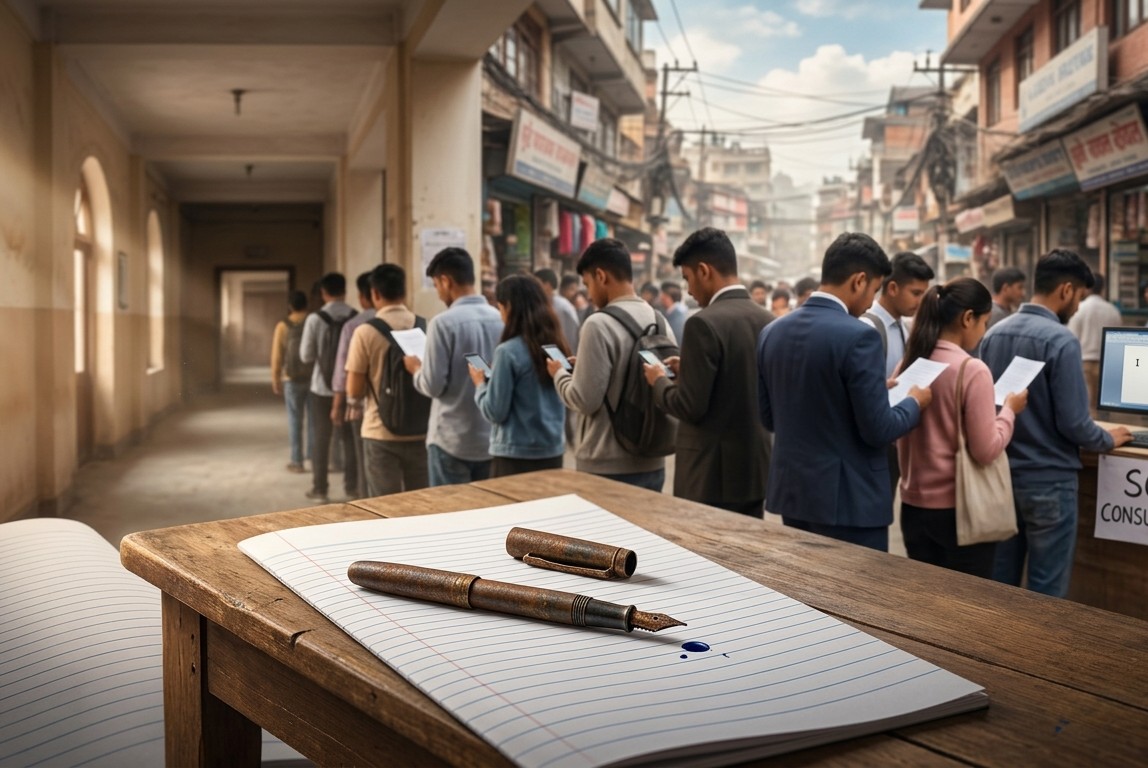
Not long ago, I found myself entangled in the gears of Nepal’s bureaucracy once again. My "Bluebook" had been seized by the Traffic Police, a penalty for a lapsed renewal. To reclaim it, I was called into the sterile halls of the Traffic Police Office and instructed to draft a formal application to accompany my fine. Outside, I encountered a scene that was both unusual and deeply telling. Typically, the perimeter of any Nepalese government office is swarmed by a dozen or more stationery stalls, thriving on the inability of the public to navigate paperwork. Here, there was only one. A long, weary queue of young people stretched from the desk, each waiting an hour or more to pay someone else to write a basic letter on their behalf. Impatient by nature, I bypassed the line, requested a pen and paper as a favor from the receptionist, who seemed genuinely startled by the request, and drafted the application myself in minutes. As I walked back inside, a haunting question lingered, Why was no one joining me? Why were these youths’ products of a modern education system and self-proclaimed Master of Information standing in the heat to outsource a skill they should have mastered in primary school? The ink in the pens of Nepal’s youth seems to have dried up long before the ideas in their heads ever reached the paper. We are a nation that prides itself on its oral history, its vibrant street protests, and its thunderous political slogans. Yet, when the shouting stops and the smoke clears, we are met with a startling silence, a generation that can roar in the streets of Baneshwor and Sahid Chowk but struggles to articulate a coherent, persuasive argument on a blank page. It has been decades since our education system promised a transition from rote memorization to critical thinking. Yet the guidebooks and guess papers that lined the shelves of my father’s generation have not disappeared; they have simply evolved into digital echoes. The diet of modern students has shifted from the textbook to the AI chatbot, consuming content without digesting it. The result is a profound ‘writing poverty’ that transcends mere grammar or spelling. It is a fundamental inability to structure thought, weigh evidence, or build a bridge between an isolated idea and its written expression. Much like the political stagnation, this is no accident of nature, it is the calculated output of a system designed to reward compliance over creativity.
.
.
The resilience of poor writing in Nepal is rooted in the historical legacy of our classrooms. For years, the Nepalese education system has functioned less as an incubator for thinkers and more as a factory for mimes. From primary school to the sprawling halls of Tribhuvan University, writing is treated as an exercise in "reproduction" rather than "production”. Students are rewarded for the fidelity with which they mirror a textbook’s phrasing, not for the clarity of their own voice. This has fostered an institutionalized fear of the blank page. When marking schemes for the SEE or Bachelor level exams prioritize the length of a paragraph and the inclusion of keywords over the depth of insight, the student learns a dangerous lesson, that writing is a ritual of volume, not a vehicle for truth. Consequently, we have produced a class of graduates who can fill reams of paper but cannot sustain a single original thesis. This crisis is further complicated by a unique linguistic paradox. In Nepal, good writing is often falsely conflated with English proficiency, even as the quality of instruction in both English and Nepali enters a state of freefall. In the frantic race to become global citizens, we have fostered a generation that is literate in two languages but fluent in neither. Many students find themselves trapped in a linguistic no-man's-land. They lack the sophisticated vocabulary to express complex socio-political ideas in Nepali, falling back on a limited, colloquial register. Simultaneously, they possess only a functional, skeletal grasp of English. This creates a hard ceiling for intellectual growth. When one lacks the precision to describe the world, the ability to critically analyze it is inherently diminished. The nuance required to challenge an authoritarian decree or a corrupt policy is lost in the translation of a mind that cannot find the right words in any tongue. The most visible and heartbreaking symptom of this decay is found in the consultancy hubs of Kathmandu, Pokhara, and Itahari. Here, the Statement of Purpose (SOP) industry has become a multi-million-rupee machine. Thousands of bright young students, aiming for universities in the West, pay strangers to write their own life stories. This is a profound admission of defeat, a generation so alienated from the written word that they must outsource their dreams, their struggles, and their very identities to a ghostwriter for a few thousand rupees. When a student cannot write three hundred words about their own aspirations, it signals a deeper spiritual vacuum. They have been taught to pass exams but never to reflect. This consultancy culture perfectly mirrors our political culture, substance is sacrificed for the right paperwork, and the form of success is prioritized over the function of the individual. This structural failure is exacerbated by the digital short-form culture of the 2020s. In the age of TikTok captions and viral Facebook rants, the disciplined labor of drafting and revising has been replaced by the instant gratification of the Post button. Writing, by its nature, requires solitude and sustained focus, luxuries that are increasingly rare in a society addicted to the dopamine hit of a like. Logic is sacrificed for speed. Nuance is buried under emojis. We are losing the stamina required for long form thought. The Gen-Z movements that shook the streets were fueled by digital energy, but that energy often dissipates because it lacks a documented manifesto or a cohesive written strategy. We have become a nation of reactors rather than reflectors. Without the habit of writing, we lose the habit of thinking through a problem, settling instead for the fragmented, reactionary discourse that mirrors our fragmented politics. I recently spoke with a university professor who lamented that his master’s students could no longer write a formal letter to the Dean without relying on ChatGPT or an internet template. "They have passion," he told me, "but they have no map." This failure is not merely an academic concern; it is a civic crisis. Writing is the primary tool for holding power accountable. Policy papers, legal challenges, and investigative journalism are the bedrock of a functioning democracy. When a population loses its ability to write, it loses its ability to document its own history and hold its leaders to their promises. Bad politics is sustained by this lack of literacy. It is easier to manipulate a crowd that reacts to a slogan than a citizenry that can scrutinize a written manifesto or point out contradictions in a budget report. The populist thrives in the fog of verbal ambiguity; they are terrified of a populace that can put their failures into clear, undeniable prose. The stagnation of writing skills in Nepal is not an inevitable byproduct of the digital age. It is the result of a system that actively punishes creativity and normalizes the shortcut. Much like our political landscape, where the same faces recycle power, our intellectual landscape is stuck in a loop of repetitive, shallow expression. Unless we dismantle the rote learning networks, shut down the SOP factories, and prioritize writing as a foundational skill for citizenship, our education system will continue to produce graduates who are ‘degreed but illiterate’. In a country where stability is often preferred over the uncertainty of change, we must realize that there is no greater instability than a nation that cannot think on paper. Until we learn to wield the pen with the same fervor we wield the protest banner, our movements will remain loud, but our progress will remain unwritten, a series of fires that burn bright but leave no record behind.