The Enduring Grip of the Old Guard in Nepalese Politics
Published: March 3, 2026
The ropes of the army helicopters over Baluwatar and Budhanilkantha...
.
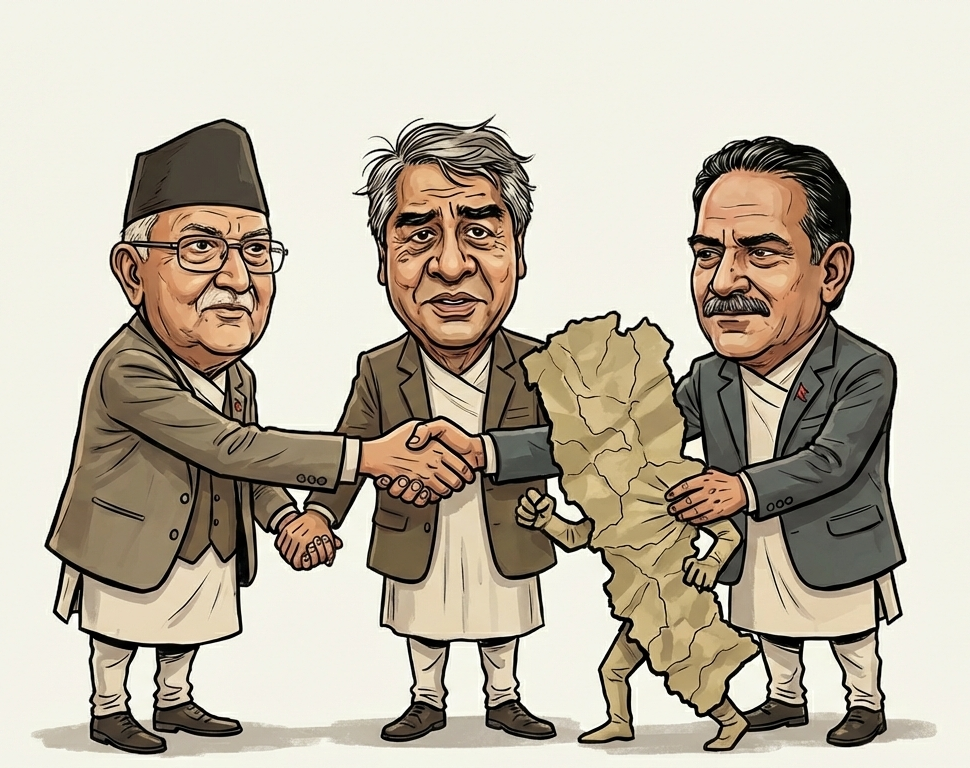
The ropes of the army helicopters over Baluwatar and Budhanilkantha, were the only thing saving Nepal's old guard from the fury of the youth. But months later, those same leaders sit comfortably in power as if the fires never happened. It has been months since the peaceful demonstrations led by the younger generation against corruption and the suppression of free speech turned violent, claiming the lives of more than seventy people due to the sheer negligence of police forces across the country. These actions were carried out under directives of Chief District Officers (CDOs), the Home Ministry, and, by extension, the Prime Minister’s office. The following day, a violent uprising of young people erupted onto the streets. Within a matter of hours, large parts of the country were set ablaze, bringing normal life to a halt. Political leaders were forced to flee, clinging to the ropes of army helicopters, and were kept under protection for weeks to shield them from the anger of the youth. Now, however, these events feel like a distant memory. The same leaders who once fled have returned to their usual selves, indifferent, unapologetic, and in some cases, openly arrogant. This has compelled me to reflect deeply on the political dynamics of our nation. Many young people like me, who had no prior political affiliation with any organization, believed that the old leaders and parties were finally finished. Yet, their continued presence and their ability to pose serious competition with newer parties and emerging youth leaders ahead of the elections in early March has become a phenomenon worth examining. Nepal’s political landscape presents a persistent paradox. Decades after the restoration of democracy and a bloody civil war, the faces at the helm often remain familiar. Leaders and political parties that are usually perceived as corrupt, ineffective, or resistant to bringing about monumental transformative change are still winning without facing any serious threat to their political careers. And strangely enough, even survive the massive public protests that have led to the loss of dozens of lives. Young generations , mobilized by frustration and a desire for change, have repeatedly risen up, only to see the traditional political elite maintain its grip on power. The surprising resilience of old parties, particularly Nepali Congress (NC) and the Communist Party of Nepal – Unified Marxist Leninist (CPN – UML), cannot be fully understood without examining historical legacy, social structures, institutional weakness, system incentives, and political culture of Nepal. This is not simply the case of inertia, nor is it merely about flawed leadership. Rather, it is the outcome of a complex interplay of structural and behavioral factors that keep the old guard at helm even when the condition for their success seems unlikely.
.
.
Among half a dozen dimensions that we are going to explore about this paradoxical phenomenon of why unpopular parties and inefficient leaders continue to shape Nepal’s political landscape, the major one is historical legacy and relevance. Their historical role in Nepal’s democratic movements is still entrenched in people’s mind, Nepalese textbooks, and parties’ propaganda pieces. Parties like Nepali Congress and CPN – UML are not just an organizations, they are national brand tied to foundational struggles of our nation, notably the pro – democracy movements against the autocratic Rana rule during 1950’s, the People’s Movement – I to end the Panchayat System and the People’s Movement – II to successfully abolish the reign of god like figures that were the Shah kings. Thus, they retain symbolic legitimacy that younger or newer parties do not yet have. Nepali Congress emerged as the leader’s force in Nepal’s first multiparty democratic experiment back in early 1950s. Again, along with CPN – UML, after the fall of the party less Panchayat System due to People’s Movement in 1990s and then after the fall of Monarchy in 2000s, its leaders emerged as key political figures in negotiation democratic transitions, enshrining democratic rights and establishing the framework for country’s steps ahead. People’s identification with these parties has deep roots, not because they are effective today but because they are associated historically with national liberation and political rights. That emotional attachments, though weakened among youth, still influences older voters and many rural constituencies. Likewise, these parties have been around since the time when the very seeds of democracy were sown in Nepalese highlands. Although irrelevant for today’s youth and Generation Z, Alpha and Beta, their influence has been deeply entrenched in institutions through the generation of people that had been inspired by their ideologies. Both CPN – UML and NC have embedded deeply in political institutions from bureaucratic appointments to controlling civil societies and even quasi – governmental bodies. This national level of institutionalization provides them with a network advantage over newer parties. These parties have organizational presence at grassroots levels, from local committees, student wings within various public colleges and labour unions. That gives them manpower to mobilize during elections especially in rural areas. In addition to this, they also have long standing connections within the civil service as they have been influencing administrative appointments during their time in power after the revolution of 1990s. This type of structural entrenchment means old parties can operate across national and local levels in a way new parties struggle to replicate quickly. Another key reason is their ability to form alliances even with their so called ideological opposite forces just to hold power. Nepalese electoral system which is based on the political ideology of multi-party parliamentary system inherently encourages coalition politics because no single party often secures a majority, parties must negotiate alliances. This system paradoxically protects old parties. For instance, in the 2022 General Election, Nepali Congress won 89 seats and the CPN – UML secured 78 seats in the HOR, the lower house of the Nepalese Parliament, far more than any other. And although being polar opposite in political ideologies, the two parties eventually formed an alliance to share the power between them and rule over the vastly unsatisfied nation. Even when newer parties like the RSP emerged as significant players, they secured only around 10.7 % of proportional votes and altogether won 20 seats in 275 seat HOR. This made them the fourth largest party but still not dominant enough to challenge the traditional leaders alone. Due to their large parliamentary bloc, the coalition bargaining power falls into the hands of the NC and CPN – UML. Coalitions like these also encourage a ‘revolving doo’’ where big parties constantly switch allies just to stay in power despite public discontent. From what I witnessed personally after the Gen-Z movement, Nepal’s political parties, particularly large old ones, suffer from weak internal democracy, entrenched leadership, and lack of internal accountability. For many years leaders have been maintaining control through loyalty networks rather than merit or performance. This has sidelined one of the fundamental aspects for healthy sustenance of multi-party democracy, internal dissent. As a result, many party members, according to my own personal analysis, choose obedience over reform because loyalty ensures advancement within party hierarchies even when larger public performance is poor. This fear based internal control allows party leaders to retain dominance even when their public performance is weak. Despite poor governance, they often continue to control party structures and secure electoral candidacies. The effects of such leader-centered politics extend beyond party boundaries. Nepal’s ethnic, caste, and religious diversity has contributed to fragmented political mobilization, where parties frequently appeal to narrow local or identity-based constituencies rather than broader national concerns. In this context, communities often vote for established parties, not because of strong performance, but in the hope of gaining protection or advantage over rival groups. As a result, emerging parties that advocate wider national agendas struggle to gain support, reinforcing the dominance of traditional political forces. Many people I have spoken to believe that new political parties offer only an abstract commitment to reform. Rather than trusting untested forces that ask them to imagine a different future and pose the question, “What if?”, working class communities in Nepal’s remote and rural areas tend to vote based on the tangible benefits they have already received. Stability is prioritized because it has enabled access to those benefits. Despite widespread frustration with corruption, voters often continue to support familiar parties due to concrete advantages such as social security allowances, election time funds, or assistance and favors in navigating Nepal’s dysfunctional bureaucracy. Having experienced four major system changes, a decade-long civil war, and multiple constitutional transformations over the past seven decades, many Nepalis are wary of further disruption. Past hopes that instability might bring meaningful change have largely gone unrealized. As a result, people engage in a mental ‘cost–benefit analysis’ and conclude that the price paid by the country and other countrymen for stability is preferable to renewed uncertainty. They are no longer willing to risk their hard-earned, if modest, sense of calm for promises that offer no immediate or visible gains. This phenomenon became particularly visible to me when I watched a video on the Instagram page of ‘IDS’, where a group of elderly women from Dadeldhura, a long-standing stronghold of Nepali Congress and the political base of its longtime leader Sher Bahadur Deuba, were being interviewed. Their remarks captured the essence of this dynamic perfectly. They said something along the lines of, “Our Sherey,” referring to Sher Bahadur Deuba, “has given us water and electricity. His people give us money and help us when our work, especially official bureaucratic work, gets stuck. So why would we vote for anyone else?” At the same time, new political parties have failed to inspire or mobilize the public in a meaningful way. They appear weak and vulnerable, largely due to their limited grassroots presence and lack of organizational resources. This makes them easy targets for political rivals, especially when they are unable to deliver quick results, unrealistic expectations within a system shaped by decades of corruption, mismanagement, and institutional neglect. Furthermore, as seen in the case of parties like the RSP, attempts to form coalitions with established parties in the hope of achieving incremental change often undermine their credibility. Such alliances expose them to justified criticism, as they are perceived to be cooperating with the very actors and practices they once pledged to challenge. The endurance of old political parties in Nepal, despite clear evidence of inefficiency, corruption and even authoritarian tendencies, is not simply a matter of political ignorance or moral failure among voters. It stems from various socio-political factors. Nepal’s political stagnation, therefore, cannot be excused as an inevitable outcome of history or voter conservatism alone. It is the result of a system that actively protects failure, normalizes corruption, and punishes genuine reform. The continued dominance of traditional parties reflects not democratic resilience but institutional decay, where loyalty outweighs competence, patronage replaces policy, and stability is achieved at the cost of accountability. While voters’ preference for predictability is understandable in a country scared by repeated upheavals, this logic has allowed entrenched elites to govern without consequence, even in the face of public suffering and protest. At the same time, emerging parties have squandered critical moments by failing to build organizational depth, offering vague reformist rhetoric, and compromising their moral authority through opportunistic alliances with the very forces they claimed to oppose. Unless Nepal confronts these structural distortion ,by dismantling patronage networks, enforcing internal party democracy, and demanding performance-based legitimacy, the political system will continue to recycle the same actors under the illusion of choice. In such a context, elections risk becoming rituals of continuity rather than instruments of change, ensuring that political renewal remains postponed rather than realized.